
TrafficAuth is powered by OmniTrust (formerly INTEGRITY Security Services)
The National Mobility Interchange, or NMI, is a secure Network V2X message routing service that helps DOTs, fleet operators, developers, and roadside systems exchange standards-compliant V2X messages over cloud-connected networks while preserving compatibility with Direct V2X infrastructure.
Secure Network Routing for Standards-Based V2X Messages
The National Mobility Interchange, or NMI, is a hosted message routing service for Network V2X applications.
NMI enables connected vehicles, mobile apps, roadside systems, infrastructure sensors, DOT applications, fleet systems, and developer applications to exchange trusted V2X messages over network connections. It is designed to support the same standards-based message content used in Direct V2X systems, while extending participation to devices and applications that communicate over cellular and cloud networks.
For DOTs, NMI creates a practical bridge between existing roadside infrastructure and the broader connected mobility ecosystem.
For developers and fleet operators, NMI provides a lower-barrier way to participate in V2X services without requiring every vehicle, app, or device to include dedicated 5.9 GHz radio hardware.


Expanding V2X Beyond the Radio Link
Direct V2X has proven the value of low-latency communication between vehicles, roadside units, onboard units, and other nearby participants. Many DOTs have already deployed RSUs and related field infrastructure to support V2X safety and mobility applications.
But Direct V2X alone does not reach every vehicle, fleet, mobile device, or application.
NMI expands the reach of V2X by enabling signed V2X messages to be routed over network connections. This allows more participants to exchange trusted transportation data, including vehicles using mobile applications, fleet systems, cloud platforms, and connected infrastructure services.
The goal is not to replace Direct V2X.
The goal is to make Direct V2X and Network V2X work together.
Relay the Same Trusted Message Content Across Both Environments
One of the most important advantages of NMI is its ability to support interoperability between Direct V2X and Network V2X systems.
Existing equipment such as Roadside Units, or RSUs, was originally built to support Direct V2X over 5.9 GHz broadcast signals. Those systems generate standards-based V2X messages for local broadcast.
NMI allows that same type of signed message content to be relayed over a network interface without changing the message format.
This helps DOTs preserve the value of existing RSU and OBU investments while extending the reach of V2X data to network-connected vehicles, mobile apps, fleet platforms, and cloud services.
A roadside system can continue broadcasting locally over the 5.9 GHz safety channel while the same V2X data is made available through NMI for authorized network participants.
Trust Travels with the Message
NMI is designed for secure, standards-compliant V2X message exchange.
The service relays messages that contain a valid IEEE 1609.2 digital signature and a certificate issued by an SCMS Manager-authorized SCMS provider, such as TrafficAuth-SCMS.
This is important because NMI does not depend on trust being created only at the network connection layer. Instead, the V2X message itself carries cryptographic proof of authenticity and integrity.
That means receiving systems can validate that:
Existing TrafficAuth/NMI materials describe NMI payloads as SAE J2735 messages with IEEE 1609.2 security wrappers and digital signatures, with signature verification recommended for production trust validation.
Designed for SAE J2735 and IEEE 1609.2
NMI is built around the established standards used by the V2X ecosystem.
Messages are based on SAE J2735 message concepts and protected using IEEE 1609.2 security. This allows NMI to support interoperability across vendors, devices, and deployment models.
Typical V2X message types may include:
NMI documentation identifies support for real-time V2X data such as SPaT, MAP, BSM, and SDSM messages, and describes NMI as a cloud-hosted V2X data exchange using a publish/subscribe model.
A Practical Protocol for Scalable V2X Data Exchange
The default protocol for NMI is MQTT.
MQTT is well suited for publish/subscribe messaging, where data producers publish messages to topics and subscribers receive the data streams relevant to their application.
This makes NMI practical for a wide range of V2X participants, including:
NMI may support additional protocols in the future, but MQTT provides a simple and widely supported starting point for scalable Network V2X deployment.
The NMI guide describes MQTT-based network access and hierarchical topic subscriptions for V2X data streams.
V2X Participation Through a Mobile App
NMI works natively with the TrafficAuth-Mobile app.
This allows users and vehicles equipped with TrafficAuth-Mobile to participate in NMI-enabled V2X services without requiring a custom embedded integration.
Depending on the deployment, TrafficAuth-Mobile can support use cases such as:
For DOTs and fleet operators, this provides a practical entry point for pilots, early deployments, and mixed environments where not every participant has dedicated V2X hardware.
Build V2X Features into Existing Applications
Developers and product teams can use the TrafficAuth-SDK to integrate NMI-enabled V2X capabilities into their own applications and platforms.
This is useful for organizations that already have a mobile app, fleet app, driver interface, roadside application, sensor system, or cloud service and want to add V2X features without replacing their existing product.
The TrafficAuth-SDK can support integration scenarios such as:
With TrafficAuth-SDK and NMI, V2X features can be added to existing workflows rather than forcing agencies or operators to adopt an entirely new application stack.
Secure Routing Between V2X Participants
1. A Device or Application Generates a V2X Message
A roadside unit, vehicle, mobile app, sensor platform, traffic system, or fleet application creates a standards-based V2X message.
2. The Message Is Digitally Signed
The message is signed using an IEEE 1609.2 certificate issued by an SCMS Manager-authorized SCMS provider, such as TrafficAuth-SCMS.
3. NMI Receives the Signed Message
The signed message is submitted to NMI over a network interface, using MQTT by default.
4. NMI Routes the Message
NMI routes the message to relevant subscribers, applications, services, or safety zones based on the deployment configuration and topic structure.
5. Receiving Systems Validate and Use the Message
Subscribers can verify the IEEE 1609.2 signature, decode the V2X payload, and use the message for alerts, visualization, analytics, signal operations, fleet services, or other connected transportation applications.
Network V2X Message Routing
NMI routes signed V2X messages between connected participants using cloud-based network communication.
Direct-to-Network Interoperability
NMI enables message content generated for Direct V2X systems to be relayed through Network V2X channels without changing the underlying V2X message format.
IEEE 1609.2 Security Support
NMI supports signed V2X messages protected with IEEE 1609.2 security and certificates issued by authorized SCMS providers.
MQTT Publish/Subscribe Model
NMI uses MQTT as its default protocol, allowing applications to publish and subscribe to relevant V2X message streams.
TrafficAuth-Mobile Compatibility
TrafficAuth-Mobile works natively with NMI, enabling mobile participation in V2X services.
TrafficAuth-SDK Integration
Developers can use TrafficAuth-SDK to add NMI-enabled V2X features to existing apps, products, and platforms.
Standards-Based Message Support
NMI supports standards-compliant V2X message exchange aligned with SAE J2735 and IEEE 1609.2.
Safety-Zone and Application Support
NMI can support smart intersections, work zones, fleet services, signal priority, vulnerable road user protection, sensor data sharing, and other connected mobility use cases.
Preserve Existing Infrastructure
DOTs can continue using deployed RSUs, OBUs, and Direct V2X infrastructure while expanding access through network-based distribution.
Expand V2X Participation
NMI allows more vehicles, fleets, applications, mobile devices, and cloud systems to participate in V2X services.
Support Hybrid Deployment Models
DOTs can combine Direct V2X and Network V2X in a single operating model rather than choosing one architecture over the other.
Maintain Standards Alignment
NMI supports standards-based V2X message exchange, helping reduce vendor lock-in and improve interoperability.
Improve Safety Application Reach
Messages from intersections, work zones, sensors, and DOT systems can reach more participants through network-connected applications.
Lower Barrier to Entry
Fleet operators and developers can participate in V2X services through mobile apps, SDK integrations, and network connectivity.
Add V2X to Existing Apps
TrafficAuth-SDK allows organizations to integrate V2X features into driver apps, telematics systems, and connected mobility platforms.
Receive Trusted Infrastructure Data
Applications can receive signed messages from intersections, roadside systems, work zones, and smart city infrastructure.
Support New Safety and Efficiency Features
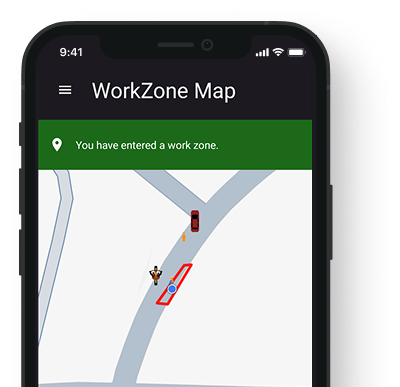
NMI can support features such as signal timing awareness, signal priority requests, vulnerable road user warnings, work-zone alerts, and fleet safety notifications.
The Bridge Between Proven V2X Infrastructure and Scalable Adoption
V2X adoption depends on both trust and reach.
Direct V2X provides proven local communication for safety-critical transportation applications. Network V2X expands participation by allowing more devices, vehicles, applications, and cloud systems to exchange trusted messages over standard network connections.
NMI brings these models together.
By routing signed, standards-compliant V2X messages across network interfaces while preserving compatibility with Direct V2X message content, NMI helps DOTs protect existing infrastructure investments and accelerate broader connected transportation adoption.
The result is a practical foundation for modern V2X: secure messages, interoperable systems, mobile and SDK access, Direct V2X compatibility, and scalable Network V2X routing.